Process automation without AI: when regular automation is the smarter choice
“Hey Robert, you do something with AI, right?”
Can AI do my work?
Outcome: his entire notification process was automated, without AI.
This case study shows why process automation, workflow automation, and structured data can sometimes be a better fit than an AI solution. Especially when emails need to be exact, customers expect consistent communication, and staff need the right information immediately.
Short answer
This automation solved a practical business problem: new customer notifications came in through website forms, had to be reviewed, assigned to staff, and communicated back to the customer. Because the process was clear and the input was structured, this could be solved with reliable automation logic and email templates. AI was not needed.
For business owners in the Netherlands, including Zoetermeer, South Holland, and beyond, this is a useful reminder: digital transformation does not always start with artificial intelligence. Often, it starts with process optimization.
How is that possible?
Well, automation has been around for a while.
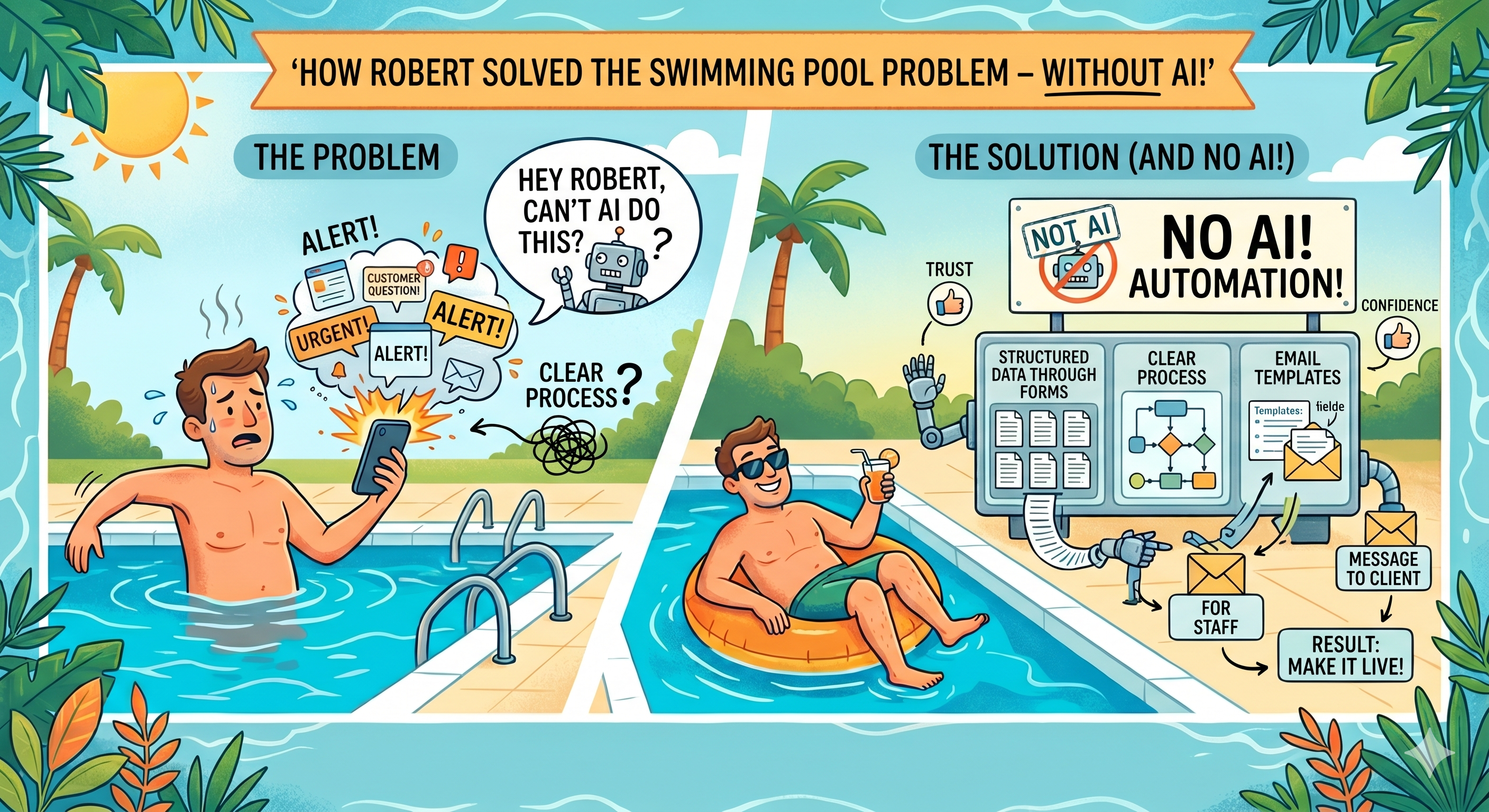
His problem was clear: when he was lying in the pool and suddenly a bunch of notifications came in, he had to get out of the pool. Not exactly ideal.
The notifications had to be reviewed, assigned to the right staff member with the right information, and the customer had to be informed about the notification and the person handling it.
This is exactly where business automation works well: fixed steps, clear decision rules, reusable templates, and predictable output.
Why did the automation process go so well?
Because of a few things:
- His process was clear
- He received structured data through forms on his website
- We did not jump straight into AI
- There was trust
It helped a lot that he knew his process exactly. It was still mostly in his head, so we needed a few sessions to work it out digitally.
Based on the structured data and the process, I could automate his requirements fairly easily by making decisions based on that data.
The emails are created from templates. Placeholders, fields filled by the automation, put the right details in the right places. The emails needed to contain very specific information and should not be slightly different every time. That is why we did not use AI.
AI versus automation
AI is valuable when you need to summarize, classify, reason, or work with unstructured information. But when the input already arrives neatly through forms and the desired outcome is fixed, classic automation is often more reliable, cheaper, and easier to control.
In this case, the goal was not to generate creative text. The goal was to process customer notifications automatically, inform the right person, and send consistent customer communication. That fits workflow automation better than generative AI.
About the trust
The first version was finished and the response was:
“Wow, this is really cool - JUST PUT IT LIVE”
Well, yes, but I still wanted to test more. What if this or that happens?
Eventually I managed to hold it back for a little while and do some more testing, but after that it went live quickly.
It had to move fast, of course, because it solved his biggest problem: no more interruptions while relaxing by the pool.
Frequently asked questions
Do you always need AI for process automation?
No. If the process is clear and the data is structured, you can often automate without AI. Think of form processing, task assignment, email templates, status updates, and customer communication.
When is AI useful in an automation?
AI is especially useful for unstructured text, summarization, interpretation, classification, or situations where several possible answers are acceptable. For fixed workflows with clear rules, regular automation is often better.
What does workflow automation deliver?
Workflow automation saves time, reduces manual errors, speeds up customer communication, and ensures staff receive the right information immediately. In this case, the main result was peace of mind: no more interruptions by the pool.
Who is this relevant for?
This is relevant for entrepreneurs, small and medium-sized businesses, and teams that want to process notifications, customer questions, forms, emails, or internal tasks more efficiently. From Zoetermeer, I help companies in the Netherlands with process optimization, AI automation, and practical workflow automation.