For months, we’ve been talking about the potential of AI to change how we work. We’ve seen chatbots that answer questions and generate text, but what about automating the entire process? What if you could have an AI agent that doesn’t just talk, but does? That’s where Anti-Gravity comes in, and it’s a true game-changer.
I recently had the chance to dive deep into this powerful tool, and I want to share how it’s fundamentally changing the way we can approach automation. Forget just prompting; we’re talking about creating intelligent, repeatable workflows.
What is Anti-Gravity?
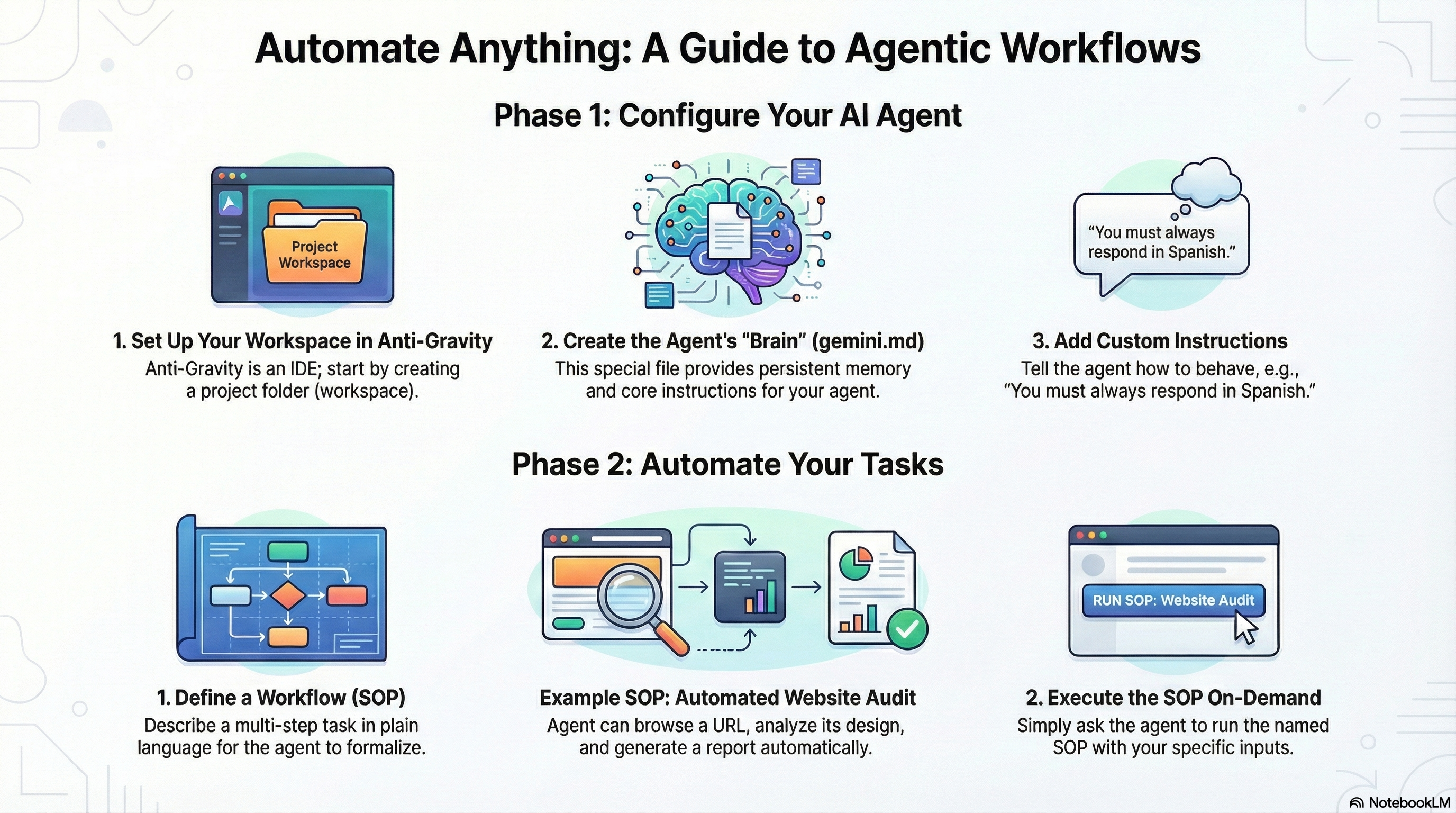
At its core, Anti-Gravity is an IDE (Integrated Development Environment). Now, don’t let that term scare you. As I often say, developers love using fancy words for simple concepts. An IDE is just a piece of software that helps developers build other software. Anti-Gravity is built on the foundation of VS Code, a tool many are familiar with, but with a crucial addition: a built-in AI agent manager.
This gives you two ways to work:
- The IDE View: A traditional code editor view where you can see your files and folders—your “workspace.”
- The Agent Manager View: A clean, chat-based interface where you interact with your AI agent. You no longer think in terms of code, but in terms of agents and tasks.
These two views are perfectly synced. What you do in one is reflected in the other. This allows non-developers to manage complex automation without ever touching a line of code, while still giving developers the power to look under the hood.
The Brain of the Operation: gemini.md
The magic of Anti-Gravity lies in a simple file: gemini.md. Think of this as the permanent memory or system prompt for your AI agent within a specific workspace. The agent reads this file every single time it starts a new task.
Want your agent to always respond in Spanish? Just create a gemini.md file and write, "You must always respond to the user in Spanish." The next time you chat, it will greet you with “Hola.”
This is where the power begins. You can fill this file with core instructions, links to your Standard Operating Procedures (SOPs), API keys, or any other foundational knowledge your agent needs to do its job effectively.
From Instruction to Automated SOP
Here’s where it gets exciting. You can teach Anti-Gravity how to perform a multi-step task and then save it as a reusable workflow.
During my session, I walked through a common task for a designer: performing a homepage audit. Instead of manually going through a checklist, I simply told the agent:
“I want you to automate an SOP for me. I do homepage audits for clients. Whenever I give you a link, I want you to use your browser to go over it and create a report covering design, typography, and calls to action. Store the final report in the ‘reports’ folder."
Anti-Gravity didn’t just perform the task once. It analyzed my request and created a new workflow file. Now, anytime I want to run an audit, I can just say, "Run a website audit for [website URL]", and it will execute that exact, detailed process perfectly every time. It even has a built-in browser automation tool, so it can literally open Chrome, scroll through the page, take screenshots, and analyze the content just like a human would.
Connecting to Your Entire Tech Stack
This isn’t limited to tasks within Anti-Gravity. The agent can connect to third-party applications using APIs. I tested this by connecting it to a job search platform called DIRStack. I stored my API key in a file and asked the agent to check the documentation and tell me what was possible. It browsed the web, read the docs, and confirmed it could perform job searches.
My next command? "Can you check my saved searches?"
Moments later, it used the API to fetch and display all nine of my saved searches. From there, I created another SOP called get-last-50-jobs. Now, I have a custom, automated workflow that connects to an external service, ready to be triggered with a simple sentence.
The Future is Agentic
Tools like Anti-Gravity are moving us beyond simple AI chat. We are entering an era of agentic workflows, where we act as pilots, defining the high-level strategy and letting our AI agents handle the complex, multi-step execution. Whether it’s lead generation, data cleaning, content creation, or client reporting, you can build a library of automated agents to handle the work.
This will drastically speed up service delivery and, more importantly, free up our time to focus on the creative and strategic work that truly matters.