If you’ve ever felt intimidated by developer tools, you’re not alone. The world of software development is filled with fancy words for things that are often quite simple. Terms like “IDE” (Integrated Development Environment) can sound complex, but at their core, they’re just sophisticated toolboxes for building software. Today, I want to talk about a tool that not only simplifies this environment but also turns it into a powerful engine for automation: Anti-Gravity.
Anti-Gravity is an IDE, much like the popular VS Code, but with a game-changing layer built on top: an agent management system. This allows us to move beyond writing code and start creating intelligent, automated workflows using natural language.
Two Views, One Powerful Engine
When you first open Anti-Gravity, you’re greeted with a familiar IDE interface. You have your file explorer on the left, a main editor window, and a terminal at the bottom. For anyone who’s dabbled in code, it feels like home. This is the IDE view.
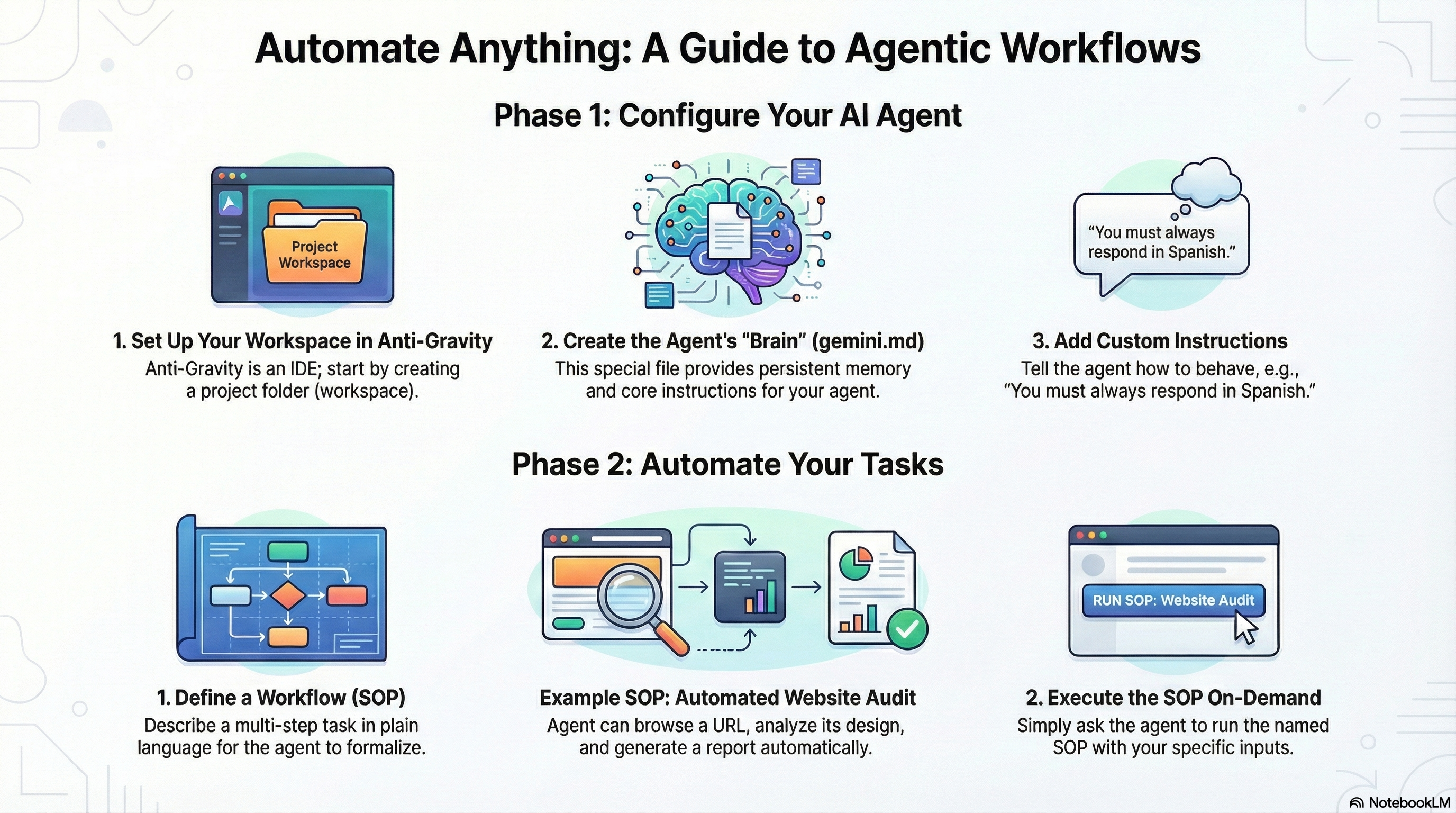
But here’s where the magic happens. With a single click on the “Open Agent Manager” button, the interface transforms. You’re no longer thinking in terms of files and code, but in terms of agents and workspaces. A workspace is just a folder, and an agent is a conversational AI that interacts with that folder. This Agent Manager view is designed for everyone, making complex automation accessible without needing to be a developer.
The Agent’s Brain: The gemini.md File
The secret sauce behind Anti-Gravity’s power is a special file within each workspace: gemini.md. This file acts as the agent’s memory or system prompt. It’s the first thing the agent reads before starting any task, giving it context, instructions, and personality.
To see this in action, I ran a simple experiment. In a new workspace, I asked the agent:
“Hey, Gemini, I’m really bad at English. Could you create a gemini.md file for you so that you always reply to me in Spanish, please?”
The agent instantly created the file with a single line: You must always respond to the user in Spanish. From that moment on, every new conversation I started in that workspace was in Spanish. This simple test demonstrates a profound concept: we can program our agent’s core behavior using plain English.
From Simple Instructions to Complex Workflows
Once you grasp the concept of the memory file, you can start building sophisticated Standard Operating Procedures (SOPs). An SOP is just a detailed, step-by-step workflow that you want the agent to follow.
For example, I tasked the agent with creating an SOP for conducting a homepage design audit for my clients. Here’s the prompt I gave it:
“I want you to automate an SOP for me. I work as a designer, and I do homepage audits for my clients. Whenever I ask you to run an audit on a web page and provide you with the link, I want you to use your browser to go over it and create a report. This report will then be stored in a report folder.”
Anti-Gravity created a detailed workflow file. The next time I wanted an audit, I simply said, "Hey, I want you to run a website audit for this website, please: [my website URL]". The agent immediately consulted its SOP, opened a browser window right on my screen, and started navigating my website—scrolling, analyzing, and compiling a detailed report. The best part? It uses its own baked-in browser functionality, so there’s no need for external tools like Playwright or Puppeteer.
Connecting to the World with APIs
The real power of agentic workflows is unlocked when you connect them to other applications. I tested this by giving my agent an API key for a service I use called DARStack. I stored the key in a file and asked the agent to go online, find the documentation, and tell me what it could do.
Not only did it browse the web and find the documentation, but it also read it and reported back on the available features. I then asked it to create another SOP to fetch my saved job searches from DARStack using the API. In minutes, I had a repeatable, automated workflow that could pull data from a third-party service with a simple command.
The Future is Agentic
Tools like Anti-Gravity are fundamentally changing how we work. We’re moving from being the doers to being the directors. Instead of manually performing repetitive tasks like lead generation, data cleaning, or creating reports, we can now build an AI agent to do it for us. We define the workflow once, and the agent executes it flawlessly every time.
This isn’t about replacing human skill; it’s about augmenting it. By automating our own processes, we can deliver services faster, operate at a larger scale, and focus on the strategic, creative work that truly matters. The learning curve is surprisingly gentle, especially if you adopt the habit of asking the agent not just to do something, but to explain what it did. This creates a powerful feedback loop for learning and improvement.
Anti-Gravity is more than just a tool; it’s a glimpse into a future where anyone can build powerful, custom automation to fit their exact needs. It’s time to start thinking like an automator.